Leadership · Operating Systems
Responsibility Without Blame, Design Over Willpower, and Sustaining What You Claim: Principles 7, 8 and 9
By Tyreek Moore ·
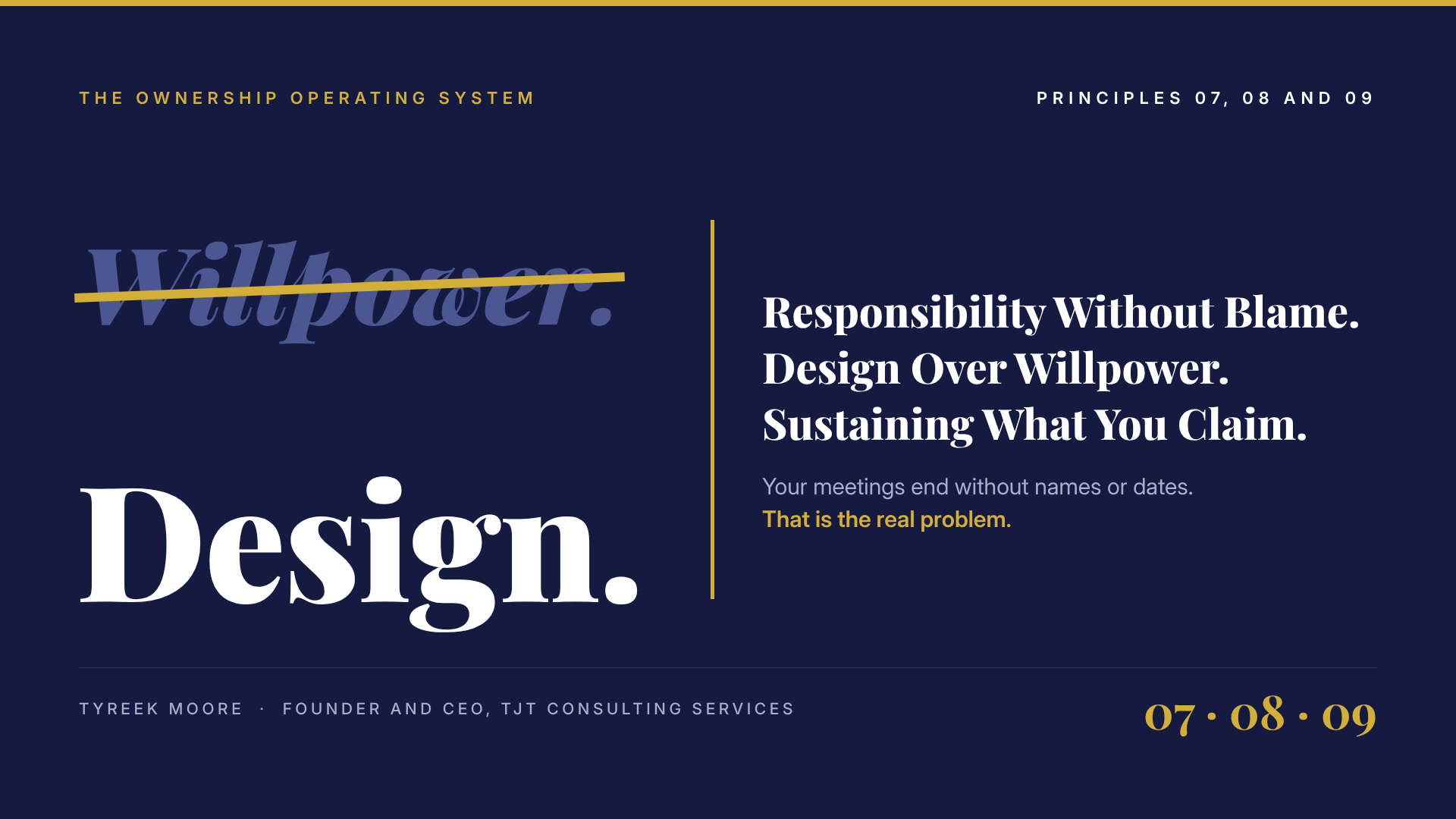
Three principles, one week
This is Thanksgiving week, so I am giving you three principles in one issue: 7, 8 and 9 of 10. Read them as a sequence. Responsibility Without Blame is how you face what went wrong. Design Over Willpower is how you keep it from happening again. Sustaining What You Claim is how you keep what you fixed.
Principle 7: Responsibility Without Blame
An employee sends a customer an inaccurate number. The mistake creates confusion and has to be corrected fast.
A blame based response asks, "How could you be so careless?" The employee starts defending their competence. The team spends time arguing about character while the customer still has the wrong information.
Blame looks backward for fault. Responsibility looks forward for ownership. A responsibility response starts with containment. What was sent? Who received it? What needs to be corrected? Who will communicate the correction? Then the team examines how the error happened. Was the source outdated? Was the review missing? Did someone bypass a known requirement? The facts decide the next action and the right accountability.
This is not softness. Responsibility Without Blame still allows a direct conversation about repeated behavior: "This is the third time the verification step was skipped. We need to understand why and establish a reliable correction. Here is the expectation going forward."
Managers own their contribution too. If instructions were unclear or the workload made checking impossible, leadership addresses that. If the process was sound and someone knowingly ignored it, that gets addressed as well. Clean responsibility identifies the actual contribution of each part of the system. It does not spread fault evenly so everyone feels comfortable.
Here is why it matters. Blame creates shame, and shame makes people hide. If reporting an error leads to humiliation, people delay. If it leads to prompt correction and fair accountability, they bring reality forward sooner, and you get more time to respond.
Principle 8: Design Over Willpower
Consider a business that says it values focused work. Everyone is expected to answer messages immediately. Meetings fill every calendar. Urgent requests arrive without priorities. Then employees are criticized for failing to finish strategic projects.
The stated value and the daily defaults are pulling in opposite directions. More reminders will not fix that. Willpower can start a change, but it is unreliable as an operating system, because energy, attention, and circumstances move. Discipline establishes the standard. Design gives the standard a place to live.
Proper design defines how urgent work is distinguished from routine work, when responses are expected, and which blocks are protected. The team needs a reliable way to reach someone in a real emergency, and permission to be unavailable for interruptions while doing the work leadership says matters.
The system should also make risk easier to surface. If someone expects to miss a commitment, where do they flag it? Who can resolve the dependency? A clear escalation path supports ownership. An obscure one creates delay, especially when raising a problem feels like admitting failure.
Then look at accountability. A team keeps hearing "take ownership," yet meetings end without names or dates, and everyone leaves with a different understanding. The fix is a closing practice, not another speech.
Design also includes what gets rewarded. If leaders praise speed while ignoring rework, people rush. If the best performer gets every rescue, they burn out while others stay dependent. The workflow, the recognition, and your own behavior all decide which actions become the norm.
Principle 9: Sustaining What You Claim
Imagine a team that solved a recurring coordination problem. They clarified handoffs, held a short dependency review, and surfaced risk early. Delivery improved. Then leadership stopped the review, because projects were running smoothly. New people joined. Priorities shifted. Everyone assumed the original agreements were still understood.
The missed deadline that followed looked surprising. The early signs were visible: an unconfirmed handoff, a decision waiting too long, a new employee unsure where to escalate.
Achieving something does not end your responsibility for it. As life improves, you get used to it, and the routine that built the result starts to feel unnecessary. If you are unwilling to own what sustains an outcome, you have not fully claimed the outcome.
Culture drifts the same way. When a senior performer ignores commitments without a conversation, the stated standard stays on the website and the lived standard becomes conditional. People start asking who is exempt instead of what is expected. What leadership tolerates becomes part of the operating environment.
Sustaining is not freezing every procedure forever. A review can get shorter as a team improves. An obsolete report can be retired. Change deliberately and check the evidence afterwards.
The tool: the four line meeting close
Before anyone leaves your next meeting, say these four lines out loud and record them where the team can see them.
- "The decision is ___."
- "The person responsible is ___."
- "The commitment is ___, confirmed by that person in this room."
- "We review it on ___."
Then add one maintenance question to your calendar for the first Monday of every month: "What practice made this work, and are we still doing it?"
What comes next
Next Tuesday is Principle 10, Living as an Owner, where all ten come together in one way of operating.
Use the holiday to look at your own system honestly. Take the 2 minute Pulse Check and see which principle your leadership is leaning on least.
All ten principles, in one place. Something arrives December 1.
Subscribe to Leadership Operating System so next Tuesday's principle reaches you.
Tyreek Moore is the founder and CEO of TJT Consulting Services. He installs leadership operating systems for leaders, teaching the Ownership Operating System together with the T.R.U.S.T. framework and the Four Voices.