Leadership · Operating Systems
Discipline Is Freedom and Identity Before Strategy: Principles 5 and 6 of the Ownership Operating System
By Tyreek Moore ·
Halfway through the ten
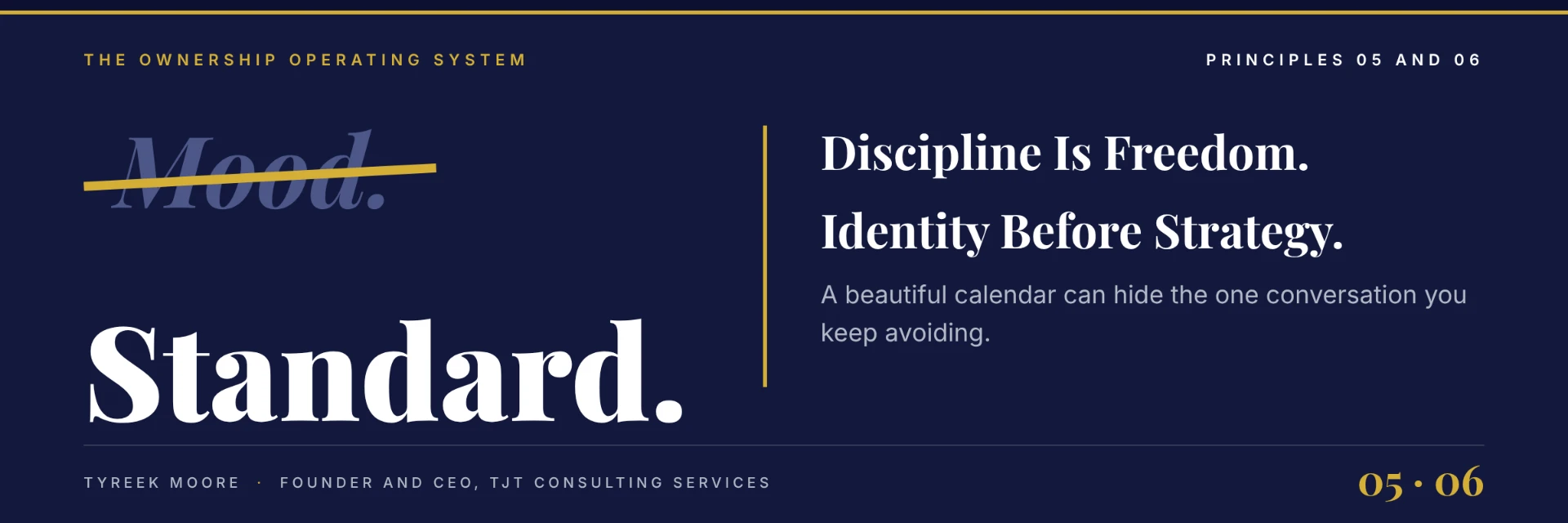
This week covers Principles 5 and 6 of 10 in the Ownership Operating System. Discipline Is Freedom is about the standard you keep. Identity Before Strategy is about the person you believe you are while you keep it. When the two pull against each other, the identity usually wins.
Principle 5: Discipline Is Freedom
Consider a manager who delays performance conversations. They want to be supportive, so they wait for the right moment. Meanwhile, the missed commitments continue. Reliable employees start carrying extra work. By the time the manager finally speaks, frustration has built up and the conversation is more charged than it ever needed to be.
That manager did not lack kindness. They lacked a standard. Without discipline, your mood, comfort, distractions, and circumstances start making decisions for you. Discipline Is Freedom means governing yourself consistently enough that your intentions do not depend on your impulses.
Discipline often gets mistaken for restriction. Look at what it actually produces. Preparing before a meeting gives you more room to think. Reviewing the numbers lets you make informed choices. Addressing a concern early gives a relationship a chance to improve before resentment builds up. Those actions cost some comfort now, and they create options you would otherwise lose.
Busy is not the same as aligned
There is a less obvious version of this problem. I call it structured avoidance. A person keeps a beautiful calendar, a clean inbox, and a long list of finished small tasks, while the one action that would change things stays untouched. The difficult conversation. The decision. They are disciplined about comfortable activities.
Being consistently busy is different from being consistently aligned. Ask what your discipline is protecting. Is it helping you face the meaningful work, or helping you stay safely occupied?
The same applies to strategy. If planning only happens after every operational request is handled, it may never get sustained attention. A leadership team can protect a recurring block for the decisions that affect future capacity, arrive prepared, name the actual decision, and leave with clear ownership. Holding the meeting is only the beginning. The discipline includes the follow through.
And check the standard itself. If a team perfectly produces a report nobody uses, perfect compliance will not make it valuable. Review whether the practice serves the outcome.
Principle 6: Identity Before Strategy
Now imagine a leader promoted from running a function to carrying responsibility for the whole enterprise. Their strategy says collaborate across the business. Their identity still says my value comes from making sure my function wins. Every shared decision feels like a loss of standing.
When behavior conflicts with identity, strategy eventually collapses. A strategy tells you what to do. It cannot tell you whether those actions will survive inconvenience, pressure, failure, and time. Ownership asks a deeper question than what should I do. It asks who must I become to produce and sustain this result.
An enterprise identity changes the questions. What serves the whole organization? Where is my function essential to that outcome? What trade off should we make together? The leader still brings functional expertise. They apply it inside a broader responsibility.
Identity is built on evidence
Psychologists call this self consistency. We are motivated to preserve familiar beliefs about ourselves, even when they limit us. That is why someone can sincerely want to change and still feel resistance. They are practicing behavior that does not yet fit how they see themselves.
You change the picture with evidence. That is why affirmations alone have limits. Saying "I am disciplined" becomes credible when you can point to commitments you kept. So choose observable behaviors. In the next resource discussion, describe the enterprise outcome before your department's need. Identify a dependency you can help resolve. Make a decision you can explain in terms of the whole business, including the cost to your own function.
Two cautions. First, the organization has to reinforce the new identity. A leadership team cannot demand enterprise behavior while everyone is evaluated only on local wins. Second, identity must stay open to evidence. "I am a decisive leader" can become an excuse for refusing feedback. "I make clear decisions and revise them when evidence warrants it" makes room for learning.
This works at home too. "I am bad with money" keeps a person from opening the accounts at all. "I am becoming someone who pays attention to my commitments and learns how to manage money" makes room for development.
The tool: the Standard and the Evidence
Take ten minutes this week and write three lines.
- The standard. One sentence you will keep regardless of mood. Steal this one for your team: "When a material commitment is missed, we discuss the facts, the impact, and the recovery immediately."
- The identity. One sentence that describes who keeps that standard, written as a developing truth: "I am becoming a leader who addresses gaps while they are still specific and manageable."
- The evidence. One observable action you will take this week that proves the sentence. Name the day and the person.
Then do the hardest item on your list before you open routine messages. Judge the week by whether the important issue moved, not by how impressive your task list looks.
Every unfinished commitment a team carries from one week into the next costs something nobody puts on a report. My free ebook, The Invisible Tax, shows you where that cost is hiding in your leadership system, and it is yours to download today.
Download The Invisible TaxTyreek Moore is the founder and CEO of TJT Consulting Services. He installs leadership operating systems for leaders, teaching the Ownership Operating System together with the T.R.U.S.T. framework and the Four Voices.