Leadership · Operating Systems
Effort Is Not Ownership and Reaction Is Surrender: Principles 3 and 4 of the Ownership Operating System
By Tyreek Moore ·
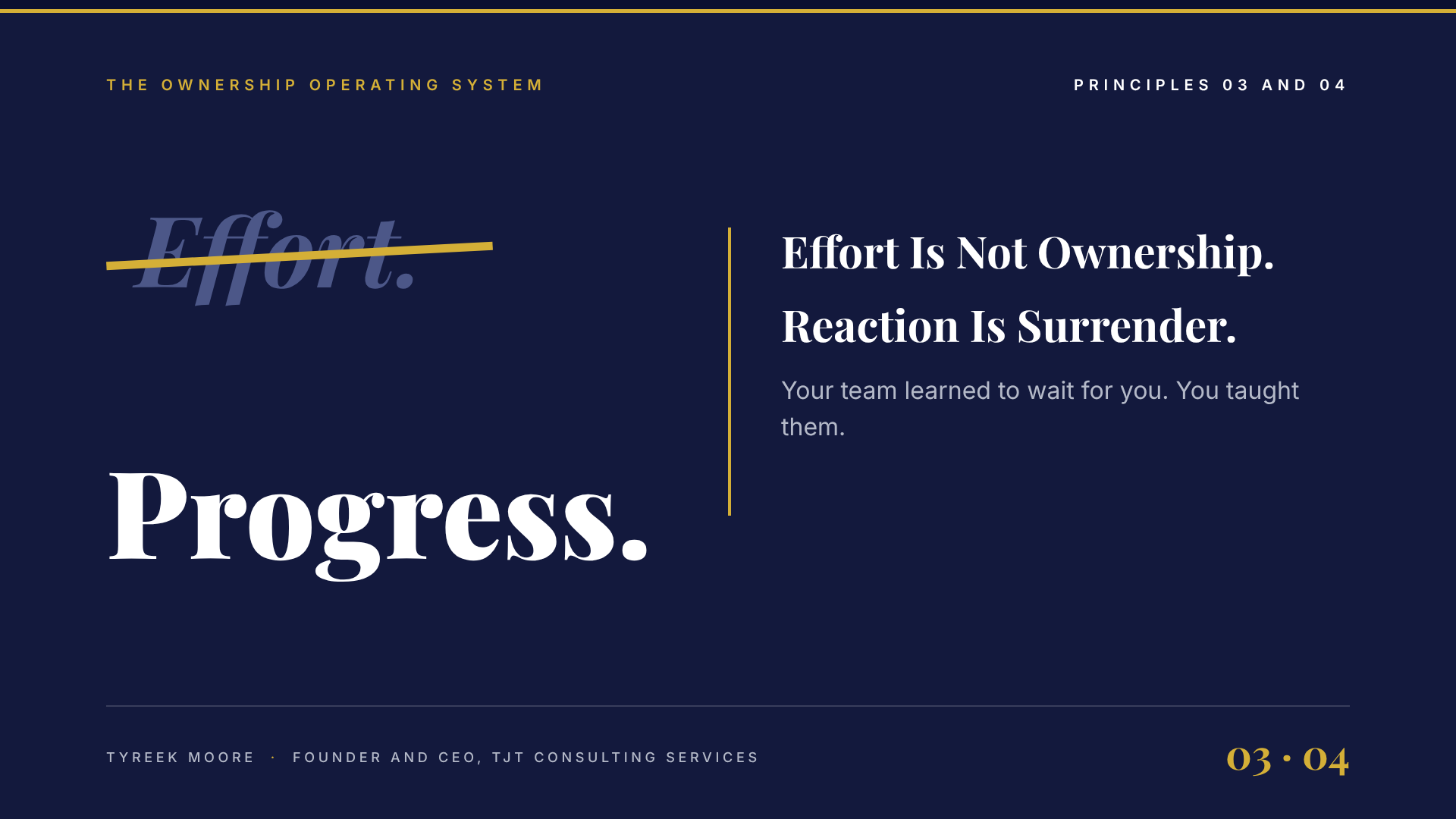
Two principles, one pattern
This week covers Principles 3 and 4 of 10 in the Ownership Operating System. I put them together on purpose. One is about how hard you work. The other is about how fast you react. In both, the leader feels busy, committed, and justified, and the same problems keep coming back.
Principle 3: Effort Is Not Ownership
Picture a manager who approves every single decision. Team members ask before moving forward, because they have learned the manager may reverse their choices later. The manager is overwhelmed and says, "Nobody takes the initiative."
Yet every time someone takes the initiative, the manager takes the decision back.
The system is teaching dependence while the leader is asking for ownership. More effort would mean answering faster, working longer, checking messages on vacation. None of that changes the pattern. Structural ownership means defining which decisions the team can make, what boundaries apply, and when escalation is actually necessary. Then the manager has to tolerate reasonable differences in how people execute. Delegation cannot build capability if every variation from how you would do it is treated as failure.
Effort measures activity. Ownership measures responsibility toward progress. The question is no longer am I trying hard enough. The question is am I doing what this outcome actually requires.
Why we defend the hard way
Two patterns keep leaders stuck here. The first is the self serving bias. Success becomes personal. Failure becomes situational. When a project works, it was my preparation. When it fails, the team did not give me what I needed. Both can hold some truth. Ownership examines your contribution across both outcomes. Did I clarify what I needed? Did I check the dependency early? Did I commit without confirming capacity?
The second is effort justification. If you gave up your weekend to finish a report, it is uncomfortable to discover a better process would have made that sacrifice unnecessary. So you defend the old approach, because questioning it feels like questioning your dedication.
Your dedication can be real, and your method can still need improvement. You can say, "I gave this everything I had, and now I can see a better way."
Recognize the prevention, not only the rescue
Take a recurring reporting error. A dedicated employee fixes it every Friday. Instead of only celebrating the rescue, ask how the data is entered, how it is checked, and who owns the handoff. Maybe a source file arrives late. Maybe two departments use different definitions. A redesign could be one agreed definition, an earlier submission time, and a validation check before the final review. Then measure whether corrections decline.
Thank the person who protected the customer, and also recognize the person who prevented the next breakdown. If the only praise goes to visible heroics, your recognition system keeps generating emergencies even while your leadership language calls for efficiency.
Principle 4: Reaction Is Surrender
Now picture a meeting where someone challenges your proposal. A reactive leader interrupts, dismisses the concern, and explains why the team should already understand.
The room goes quiet. That silence may feel like agreement. It is often people deciding that speaking up costs too much. The leader gained compliance and lost access to information.
Reaction Is Surrender means you may not control the stimulus, but you remain responsible for the response. The moment an external event determines your behavior, something outside of you is governing you. Emotion is real. Pressure is real. Ownership does not deny any of it. It requires you to keep authority over what happens next.
That does not mean staying silent or letting someone cross a line. Your anger may point to something that needs to be addressed. The question is how you address it.
The story your threat response writes
When a threat response fires, your interpretation becomes more certain. They are disrespecting me. They are trying to undermine me. This always happens. The facts may deserve concern, but the immediate story is still a story. Learn your own signs, a tight jaw, a rising heart rate, the urge to interrupt, and create an interruption: a slower breath, a clarifying question, the phone set down before you reply. Then separate the facts from your interpretation. What was actually said? What am I assuming? What outcome do I want?
The same pause works at home. "We agreed this would be finished before dinner. It is not finished. Tell me what happened." The standard stays visible, and you get the information you need. And if you already reacted, go back: "I raised my voice, and what I said was unfair. I own that. We still need to address the agreement." Repair does not require abandoning the standard.
Reactions travel. A sharp response to one person changes how everyone reports problems. If people expect anger, they wait for a perfect explanation before sharing bad news, and you learn about risk when fewer options remain. Your emotional behavior affects the quality and timing of the information you receive.
The tool: two scripts and one test
When someone challenges your proposal, say: "I hear a concern about the assumptions. Which assumption do you believe creates the biggest risk?" That does not concede the proposal is wrong. It invites the evidence you need.
When the challenge is poorly delivered, say: "I want to understand the risk you are raising. I also want us to discuss it without personal accusations."
Then run the absence test on your own effort. Ask what would happen if you were gone for a week. Would the improved process continue, or would every decision wait for your return? That is a useful test of whether your effort built capacity.
If your team is still waiting on you for decisions it should own, book a discovery call and we will look at the system producing that pattern.
Book a discovery callTyreek Moore is the founder and CEO of TJT Consulting Services. He installs leadership operating systems for leaders, teaching the Ownership Operating System together with the T.R.U.S.T. framework and the Four Voices.